
SOFT INSTRUCTIONS
Written by Fanfan Yuxuan FAN.
FANFanFlus and Art Cake are delighted to present a three-artist exhibition, curated by Fanfan Yuxuan Fan. Soft
instructions refers to forms of power that operate within intimate relationships without appearing as explicit
commands. Subtle and often imperceptible, they quietly choreograph emotions through interactions that come to
feel natural, consensual, or caring. Mediated through the language of care or devotion, these instructions are
willingly accepted—even relied upon—for their promises of safety, belonging, and the sensation of being loved.
Thus, attachment may be understood as punitive or constraining, emerges as a primary site through which power
is sustained, internalized, and normalized in our everyday lived experience. This exhibition unfolds the tensions
of intimacy across three interrelated layers: erotic scenarios structured by role assignment and reversal; the
subtle disciplining of posture through objects and infrastructural arrangements; and sonic-religious spaces that
regulate visibility and audibility, determining which identities may appear or be heard, and which may not.
Yshao Lin confronts power structures by working through the terrain of intimacy. In Not Even God Can Judge Me (2026), he summons muscular white men via dating apps, dresses them in black suits, and directs them into submissive postures. This gesture subverts the logic of Western pornography that aligns white masculinity with dominance and Asian masculinity with passivity. The suit, an emblem of authority, is redistributed. Lin plays the roles of director and confessor, turning shame into gazed-upon evidence, exposed, and recorded. When the Cicadas Cry (2025) suspends judgment and generation: gold-painted, incomplete cicada shells can no longer move, yet their absence persists through sound. Mechanical echoes of a summer long prepared in the dark and released in a brief eruption condense migratory dislocation and temporal delay, settling into a quiet mourning for seasons already sealed away. Here, soft instructions emerge through a double bind of desire and memory, exerted outwardly upon others while simultaneously turning inward toward the self.
Soomin Kang translates soft instructions into objects and installations, shifting attention to micro-discipline embedded in everyday material forms. Works such as Soft Exit (2025) and Hold It (2025) transform fitness handles, animal restraint toys, and objects with misaligned functions that appear caring yet subtly prescribe the body’s “correct” postures. Hovering between handrails, toys, and training devices, these objects blur the boundary between care and constraint. They seem to support the body while simultaneously instructing it on how to exist compliantly and obediently, how to desire and submit within permitted boundaries, rendering love, care, and discipline increasingly difficult to distinguish.
Gabriel Siams examines religion as a spatial and symbolic system through sound, absence, and embodiment. In Madonna's Runway (2025), the artist’s queer body moves through the interior of Antwerp’s Sint-Pauluskerk in high heels. Gender remains indeterminate, and the figure is visually withdrawn. The sharp echo of each step becomes the sole perceptible presence, set against an environment shaped by ornately carved confessionals articulated through sculptural reliefs, where only angelic figures retain feet, while saints and followers of Christ are depicted without them. In this context, sound functions as a residual trace of presence, familiar and unsettling. It gestures toward a queer corporeality long embedded within Catholic spaces, yet rendered imperceptible by their visual and symbolic regimes. Gender, posture, and identity condense into resonance, as sound itself becomes the medium through which soft instruction operates: at once exposed and erased, existing as the sole permissible trace of presence. Soft Instructions are repeatedly enacted, tacitly permitted, and even desired within intimacy. It shapes how desire and attachment operate under the signs of care and control, allowing power to appear absent while embedding itself more deeply in everyday life. The works of the three artists reveal the persistence of this gentle yet enduring force: when soft instructions become more visible, can intimacy be reimagined beyond compliance, toward forms of closeness that neither demand obedience nor erase difference?
CURATOR
Fanfan Yuxuan FAN
Fanfan holds dual bachelor’s degrees in Arts Administration from the Central Academy of Fine Arts and KEDGE Business School, and is currently pursuing her M.A. in Visual Arts Administration at New York University. She has worked for Asia NOW Paris Art Fair in Paris as well as Eli Klein Gallery and Marc Straus Gallery in New York. Based in New York, her curatorial approach is grounded in artist-practice–driven methodology, spotlighting emerging post-90s artists and examining the shared challenges and aspirations of her generation through nomadic, site-responsive projects.
ARTISTS
Yshao Lin
Yshao Lin (Born in Fuzhou, China) is currently an MFA candidate in Expanded Practice and Sculpture at Columbia University. He holds a BFA from the School of the Art Institute of Chicago. Working across artist books, photography, new media, and installation, his practice draws on personal memory, displacement, and lived experience. His works examine migration, belonging, and cultural negotiation under modernization. Lin has been selected for Antoine d’Agata’s residency in Arles, France, the New York Times Portfolio Review, and the Flash Forward Award (Canada). His work has been exhibited internationally, including at Tate Modern’s COME TOGETHER: ART AND POLITICS IN A CLIMATE OF UNREST, and is held in institutional collections such as Jiazazhi Photo Book Library (China) and the Joan Flasch Artists’ Book Collection.
Not Even God Can Judge Me (2026) is a performance-based project that stages sexual fantasy as a critical device to examine race, power, desire, and shame. Muscular white men are invited via dating apps into their own domestic spaces, dressed in black suits, and directed into humble, submissive postures—reversing the roles typically assigned to Asian men in Western pornography. The suit, a Western emblem of authority, masculinity, and class, is recast as a mutable costume whose symbolic power is reassigned and destabilized. Rooted in the artist’s upbringing within a traditional Christian Asian family, the work functions as a form of confession, confronting sexual desire openly rather than concealing it within guilt and silence. By placing these men under control and fixing them through the camera, the project subverts conventional power relations between white and Asian masculinity. The resulting images operate simultaneously as evidence and fantasy, staging an inversion of who is seen, who obeys, and who holds the authority to judge.
When the Cicadas Cry (2026): A small constellation of cicadas lies on the ground—3D-printed and painted gold, their wings and legs already gone. Under a flickering light, their shadows stutter, while a thin, looping sound rises from bodies that can no longer move. Once known for a long subterranean preparation followed by a brief, ecstatic emergence, the insects appear here suspended midway, as if becoming itself were interrupted. The sound, now enclosed within an artificial space, returns as a faintly mechanical echo of summer—no longer lived, only recalled. Gold renders the damaged shells luminous, almost sacred, even as their incompleteness remains undeniable. What persists is not the insect, but its vibration: a quiet mourning for seasons already seale
Soomin Kang Soomin Kang is an artist currently pursuing an M.F.A. at Columbia University School of the Arts. She received a B.F.A. from the Korean National University of Arts in Seoul. Kang’s practice explores how physical structures shape bodily experience, asking how bodies are managed and imagined across public and private spaces. She is particularly interested in how familiar forms and gestures, such as holding, binding, and pressing, recall sensations before language. In her process, she alters and reassembles objects like furniture, plastic toys, medical devices, and animal restraint structures. By misaligning their functions, she exposes the traces and tensions of bodily presence held within their forms, where structure becomes both a proposition and a demand. Her works seek out the soft threshold between containment and care.
Soft Exit (2025) transforms gym grip handles into suspended swings. Each swing is fitted with a single hook, suggesting a body's presence yet remaining inaccessible. Though they appear to offer rest or play, the work quietly exposes the tension between support and restriction.
The Sinks (2025) reconstructs parts of Soft Exit's packaging into a different bodily support. Curves drawn from body-related products are absorbed and reshaped into holding structures. Using a weight-lifting bar, the work traces how these forms are taken back into the body's own structure and use.
Toys For (2025) begins with a floor of commercial vinyl tiles commonly used in institutional settings. Toy-like objects are arranged across the surface, forming a space that resembles a playroom. Through their colors, materials, and visual familiarity, the objects invite impulses of interaction and play while their functions remain unclear. The work constructs a playground from tools that resist fixed use, shaping a space defined by attraction, hesitation, and suspended action.
Gabriel Siams Gabriel Siams' (1996) trajectory as a transmedia artist has been influenced by his childhood in a religious environment. Accompanying his mother to church every Sunday exposed him to the power of symbolism and the possibility of subverting it. By transforming this formative experience into a focal point of exploration, his research delves into the relationships constructed from ancient symbologies, which may date back to before Christ and continue to be present in contemporary culture. Siams also explores the potential for transformation of materials, moments of transition, and states of indefiniteness; the intermediate, the ambiguous, the malleable. Through installation, photography, moving image, performance, and sound, his practice takes on various forms, between narrative and documentary, but not conforming to one form or the other.
Madonna’s Runway (2025) is a site-specific piece featuring the resonance of heels echoing through the interior of Sint-Pauluskerk (Antwerp, Belgium). The work references the absence of feet in the church’s confessional sculptures — an omission applied to all figures except the angels.

Installation View of Soft Instructions

Installation View of Soft Instructions
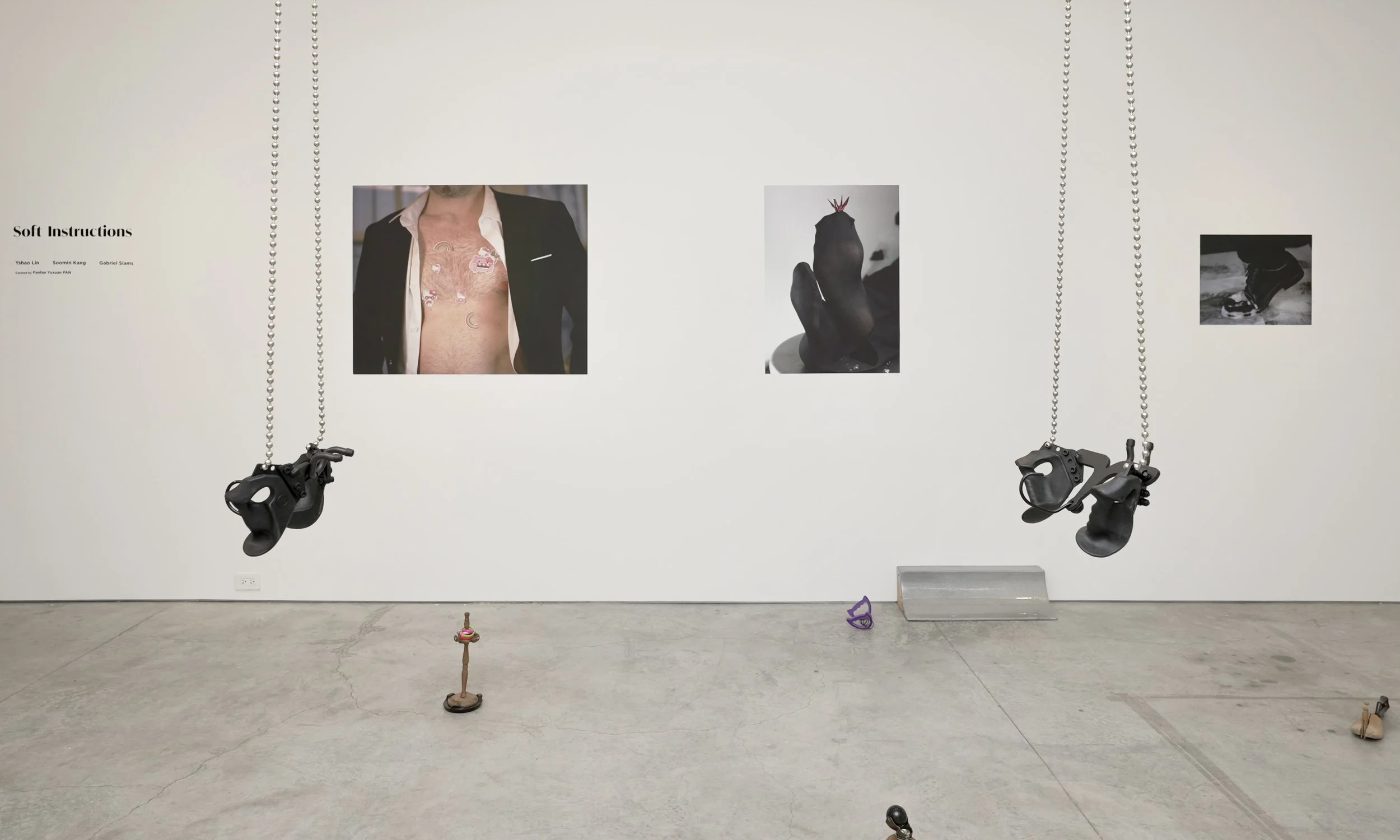
Installation View of Soft Instructions

Installation View of Soft Instructions

Installation View of Soft Instruction

Installation View of Soft Instruction

Installation View of Soft Instruction